
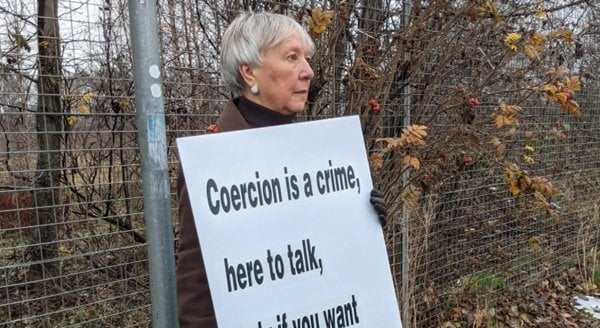
A “buffer zone” speech censorship case has been dismissed after prosecutors failed to show anyone was there to be influenced by a sign held by a grandmother who simply offered a conversation.
The case in Scotland was handled by ADF International and its legal counsel, Jeremiah Igunnubole, called on the Crown Office and Procurator Fiscal Service “to cease such targeted prosecutions and instead focus their resources on tackling the serious and growing crime problems Scotland faces.”
He said the prosecution of Rose Docherty was “emblematic of the deepening free speech crisis in the U.K.”
“Above all,” he said, “this case has starkly exposed the flaws in these poorly drafted, censorial, and undemocratic ‘buffer zone’ laws. They have created confusion for police officers and delivered injustice to Rose and others who have endured the humiliation of arrest, imprisonment, and prosecution simpl for seeking to love their neighbor and exercise their rights in the gentlest manner possible.”
In court, Docherty’s counsel explained that the charge was insufficiently clear and was not “prescribed by law,” since it failed to state or identify another person in the “buffer zone” who was present for the purpose of accessing, providing, or facilitating the provision of abortion services, as is required by the law.
The legal team explained, “During the hearing on April 20, the Crown admitted that the presence of another individual within the zone who was accessing, providing or facilitating the provision of abortion services was an essential ingredient of the offense and, remarkably, conceded that they were still making enquiries as to how many people, if any, were influenced by Rose’s conduct within the zone.”
The case claiming Docherty was “influencing” in a “buffer zone” was dismissed by Sheriff Stuart Reid’s ruling.
She was the first person to be criminally charged under Scotland’s censorial 2024 “buffer zone” law.
She was standing in the vicinity of Queen Elizabeth University Hospital in Glasgow and was holding a sign that said, “Coercion is a crime, here to talk, only if you want.”
Prosecutors conceded during the hearing they had no evidence of people being present in order to be “influenced.”
The legal team confirmed Docherty “did not approach anyone, did not speak about abortion, did not engage in any behavior that was obstructing, harassing or intimidating and was not protesting.”
Her arrest triggered protests from the Scottish Catholic Bishops Conference as well as the U.S. State Department.
Scotland’s law is similar to the Public Order Act which censors speech in England and Wales.
Docherty said, in a statement released by her counsel, “This verdict is a major victory for free speech in Scotland and the UK. It shows that peacefully offering consensual conversation on a public street, which is all I have ever done, can never be a crime.”
She pointed out that the prosecution itself was a punishment, and called for it to be changed.
* * *
Content created by the WND News Center is available for re-publication without charge to any eligible news publisher that can provide a large audience. For licensing opportunities of our original content, please contact [email protected].
This article was originally published by the WND News Center.