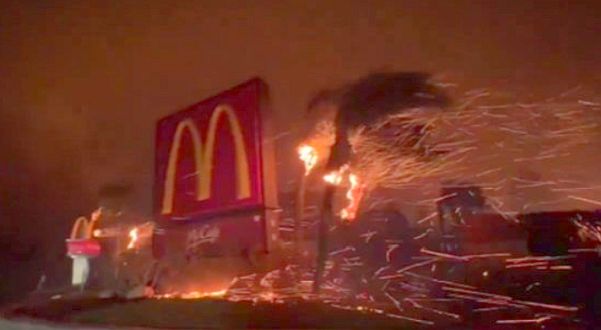
One video has appeared online that shows those not caught in the conflagration why the raging wildfires now consuming neighborhoods across Los Angeles are so damaging, and so hard to fight.
It’s the winds, which have gusted to 40 mph, 60 mph, 80 mph and even more.
Los Angeles last night … a night from apocalypse!!
Sad
— حسن سجواني Hassan Sajwani (@HSajwanization) January 9, 2025
Wildfires always have the potential to be explosive, but they often end up being at their worst when winds fan the flames, and send burning cinders literally across the landscape to ignite more and more locations.
The causes of the multiple fires burning across the Los Angeles region have not been officially identified. It could be powerlines blown down by winds. It could be carelessness, it could be terrorism.
But the winds are turning them from damaging storms into all-consuming beasts that offer no exit.
There already have been at least five deaths in the LA inferno, and upward of 2,000 buildings destroyed.
While the city’s preparedness now is coming under fire – for fire hydrants without water, officials who ignored warnings about this very type of event, and “diversity” agendas being made a priority by fire officials – the damages are huge.
And it’s not the first time this very scenario has played out in America, so officials were on notice.
In 2021 in Colorado, the Marshall fire destroyed some 1,000 residences in Boulder County. Sparked amid a windstorm with gusts that topped 100 mph, it ignited the northwest corner of the Denver metropolitan and burned unhindered.
Officials also cited the Chimney Tops 2 Fire in Tennessee in November 2016, when downslope winds pushed flames into Gatlinburg, killing 14 and burning more than 2,500 homes.
Published reports cited Jon Keeley, of the U.S. Geological Survey and adjunct professor at UCLA, who said Los Angeles became victim of the Santa Ana winds.
They are strong gusts that blow down the mountains toward the California coast. They develop when there is high pressure to the east and low pressure system off the coast. And the setup is similar to Colorado’s wind conditions with adjacent high- and low-pressure systems during the Marshall disaster.
In all of the wildfires enhanced by uncontrolled winds, drought also was a key factor.
* * *
Content created by the WND News Center is available for re-publication without charge to any eligible news publisher that can provide a large audience. For licensing opportunities of our original content, please contact [email protected].
This article was originally published by the WND News Center.