
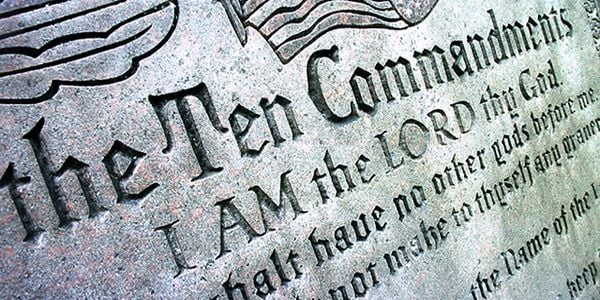
An historic Ten Commandments monument, originally donated to be used at the state Capitol in Frankfort, Kentucky, years ago but moved in the 1980s for construction, then banned from returning under a faulty U.S. Supreme Court test in the Lemon case, has been returned.
Word comes from the legal team at First Liberty Institute, which represented the Fraternal Order of Eagles Aerie 3423 of Hopkinsville, which has protected the monument for all these years.
The re-installation of the monument honoring the foundations of American government came about after the lawmakers adopted a resolution calling for the action.
“We congratulate the people of Kentucky for restoring a part of their history,” explained lawyer Roger Byron of First Liberty.
“There is a long tradition of public monuments like this one that recognize the unique and important role the Ten Commandments have played in state and national history. The people of Kentucky can now enjoy their monument whenever they visit their Capitol.”
It was Kentucky House Joint Resolution 15 that was passed by the legislature, with an overwhelming majority in both houses, that became law just this year.
It ordered the restoration of the monument.
The Hopkinsville Aerie had maintained the monument for more than 20 years, and agreed to allow its return to the Capitol.
Aerie spokesman Vic Jeffries said, “We are thrilled to return the Ten Commandments monument to the Commonwealth and have it back where it belongs. The Eagles have donated over 100 Ten Commandments monuments to state and local governments over the years, and we’re glad to have ours back on the state Capitol grounds, its historic location.”
First Liberty explained the monument was on the Capitol grounds until the 1980s when it was moved for construction work.
Then the “Lemon” test was adopted by the Supreme Court, a failed ruling that restricted Americans’ speech and religious rights.
That precedent was knocked down a few years ago, and that conclusion was affirmed in the 2022 Kennedy v. Bremerton School case.
The Supreme Court has explained the Ten Commandments “have an undeniable historical meaning,” including, “historical significance as one of the foundations of our legal system,” and “[s]uch acknowledgments of the role played by the Ten Commandments in our Nation’s heritage are common throughout America.”
The monument originally was donated in 1971.
Lawmakers had approved the return in 2000, but the move was blocked at the time by a federal court using the faulty “Lemon” test.
First Liberty explained, “Not every citizen in our country is religious or of the same faith tradition. While we have different beliefs, this does not mean that government can hide the religious parts of our history and heritage. Doing so is discriminatory and runs afoul to what religious liberty is about. Bottom line, it’s a great disservice to our country when government decides to censor public religious displays.”
The team said, “Displaying the Ten Commandments in public spaces such as state capitols benefits everyone because it reminds us of the foundations on which our country is built.”
David Walls of the Kentucky Family Foundation told reporters during the dispute, “It’s about restoring a historic monument and ensuring the next generation of Kentuckians has the ability to recognize the historic importance of the Ten Commandments.”
* * *
Content created by the WND News Center is available for re-publication without charge to any eligible news publisher that can provide a large audience. For licensing opportunities of our original content, please contact [email protected].
This article was originally published by the WND News Center.