
Note from WND News Center Editor-in-Chief David Kupelian: America is experiencing extreme turmoil right now, its politics, culture, public safety and even its sanity all under attack – polarization and rage so great that three different people have tried to assassinate the president in less than two years.
Living through such national crisis, it’s understandable that many Americans might look wistfully toward their nation’s upcoming 250th birthday celebration, in hopes that some way, somehow, it might bring a measure of healing to their nation. That perhaps remembering and reliving that era – with all the courage, faith and sacrifices of those who gave us the freest, most prosperous, most powerful and most Christian nation on earth – might possibly help restore America to its former greatness and goodness.
That, no doubt, is at least part of why bestselling author Eric Metaxas wrote his newest book, “REVOLUTION: The Birth of the Greatest Nation in the History of the World.” But when I asked Eric for permission to publish an excerpt on WorldNetDaily, a request to which he graciously agreed, I really had no clue what I was in for.
Here’s what I mean: As an American growing up during the 1950s and ’60, I learned about the American Revolution like every schoolkid did – Britain’s heavy-handed “taxation without representation,” the Boston Massacre and later the Boston Tea Party, the “Intolerable Acts” followed by convening the First Continental Congress, Thomas Paine’s “Common Sense,” the battles of Lexington and Concord (and “the shot heard ’round the world”). I knew the basics.
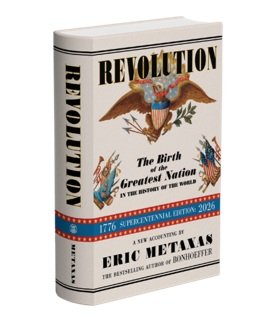
But what Eric Metaxas has done here is to virtually transport readers to the mid-1700s where they are placed right in the midst of the conflict, intrigue and heroism – probably as close as one can get to “being there” without the benefit of a time machine. Reading “REVOLUTION” enables the reader to experience, moment by moment, what America’s forefathers really went through in order to bequeath to us the greatest nation in history.
So I highly recommend reading “REVOLUTION” to really understand and appreciate, perhaps as never before, the gift God has given to all Americans – and the supreme importance of protecting and defending that nation today.
Here’s a special offer from Eric Metaxas: Though “REVOLUTION” is scheduled for national release June 2, Eric says, “If you’d like to read the entire book RIGHT NOW, simply pre-order your copy and email a screenshot of your receipt to [email protected], and you’ll receive the PDF immediately.”
Here now is the “Introduction” to Eric Metaxas’ “REVOLUTION: The Birth of the Greatest Nation in the History of the World.”
*******
ONCE UPON A TIME there was a Revolution.
Abraham Lincoln said that the “new nation” born of that Revolution in 1776 was “conceived in liberty and dedicated to the proposition that all men are created equal.” When we think of a conception we think of a clear beginning – of a spark ex nihilo – so it’s not too much to say that the conception of the country we call the United States of America occurred when the idea of liberty went forth from the eternal mind of God, entering history and time. But when exactly was that?
Many of the men of the Revolution – having a view of history involving “providential dispensation” – believed that this first happened when the Israelites made a covenant at Sinai, and that the fire from this initial spark traveled through the centuries, flaring up slightly and briefly here and there in the city-states of ancient Greece and the Roman republic and then mostly went underground again, until after the Reformation it had gathered enough energy to leap across the Atlantic, where in a handful of communities the flame was cherished and carefully guarded until – being threatened – it was seen to burst more generally into view in the events we shall be discussing.
So the American nation – “conceived in liberty” and born in 1776 – is the geopolitical expression of that Revolution, of that glorious idea from outside this world that came into the world. There has never been another nation like it. Of course, after its birth 250 years ago, it has continued to exist – and not merely to exist but to grow dramatically, ideally developing along the genetic lines established in the moment of conception. But in order for that to happen, it is inescapably vital that the citizens who form that nation are aware of the glorious events of that conception and that birth, so that they may rejoice in them. That is the principal reason for the existence of this book.
Although this book might have been titled “The American Revolution,” it is simply titled “Revolution,” because the Revolution we often call the American Revolution is the only genuine revolution in the history of so-called revolutions, and therefore stands quite alone, requiring no adjective. Our Revolution set the standard and is the model, such that nothing that has called itself a revolution can seriously compare with it. The French Revolution was ultimately a tragic and failed revolution, and the Bolshevik or Soviet Revolution was the cynical and demonic parody of a genuine revolution. Perhaps the Greek Revolution of 1821 comes closest, although even that cannot really begin to compare with what happened during our own Revolution. As ever, John Adams may have said it best. In a letter to his friend Benjamin Rush in June 1776, he said, “We are in the very midst of Revolution, the most complete, unexpected, and remarkable of any in the history of the world.”
The Revolution that took place in America in the eighteenth century was a world-changing event and was therefore an international event, one that had never happened before and can never happen again, any more than the Big Bang – or the events of the Crucifixion and Resurrection – could happen again. It was a singularity in world history. Because the nation born of that Revolution was “dedicated to the proposition that all men are created equal,” it took all of humanity into a new epoch.
The ‘Revolution Before the Revolution’
Some would say that the Revolution began on April 19th in 1775, at the moment of “the shot heard round the world.” We will certainly come to that glorious moment, which is indeed a blood-red marker on the timeline of history, and deserving full recognition as such. And yet that date only marks when the war began, which we call the Revolution. John Adams said that there was a Revolution before the Revolution. So before we get to the war and the birth of the nation – as we certainly shall – we must first visit a number of scenes that prepared the way for the eventual explosion into war. So before we turn the historic corner of Lexington and Concord in 1775, and then proceed to the sacred year of 1776, and continue through the scenes of the war that did not officially end until 1783, we will first visit those previous scenes – those shrines along the way of our Revolutionary pilgrimage – to understand how the war we call the Revolution came to happen.
According to John Adams, the first of these scenes took place in a Boston courtroom in 1761, as we shall see. But the second – and perhaps the grandest of them all – concerns the Stamp Act in 1765, which was the kick-off to everything that would follow, only lacking confetti and balloons. And then there were the Townshend Acts in 1767, and the chilling moment in 1768 when British troops arrived in Boston, and then the bizarre explosion in 1770 that was the Boston Massacre, and then the Boston Tea Party in 1773. It is only in knowing the exquisite dramas of each of these scenes in the “Revolution before the Revolution” that we can be properly prepared for the momentousness of the war we call the Revolution.
Part of why we must visit these scenes is to see just how stunning it all was to the British, who in the years leading up to the Revolution tragically failed to read the tea leaves, so to speak. They could hardly have been more ignorant of how the Colonies – three thousand miles away – had been developing over the previous 150 years. By the time of the Revolution, they seemed shocked to find themselves fighting with a people from whom they were quite alienated, and whose cultural language they did not speak. They were flabbergasted when we dared to disagree over whether they could tax us, and more flabbergasted when we took up arms in defense of our principles about this, and most flabbergasted of all when we continued to fight and fight, as though we earnestly cherished those principles more than life itself, which as it happened, we did.
NOTE FROM THE PUBLISHER: At 600 pages – with photos and illustrations – “REVOLUTION” is definitive and sweeping, an astonishing epic containing a dazzling array of stories, ranging from the explosive events that led up to Lexington and Concord, all the way through the impossible twists and turns of the war itself – including the Battle of Bunker Hill, the Crossing of the Delaware, Saratoga, and the bitter winter at Valley Forge – all the way to the final victory in Yorktown and “The World Turned Upside Down.”
Unless we ourselves know the true story of the Revolution – what some have called America’s “founding myth” – we cannot play the role we are meant to play in the Revolution that still continues today.
SPECIAL OFFER: Pre-order “REVOLUTION” now and email a screenshot of the purchase receipt to [email protected] in order to receive a PDF of the whole book immediately.
* * *
Content created by the WND News Center is available for re-publication without charge to any eligible news publisher that can provide a large audience. For licensing opportunities of our original content, please contact [email protected].
This article was originally published by the WND News Center.