
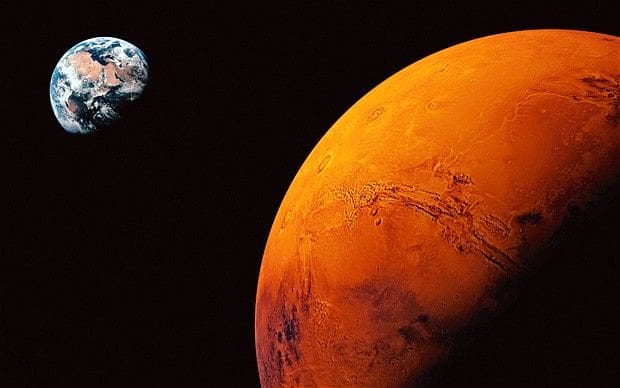

While the Daily Mail boldly said, “NASA has announced the discovery of microbial life on the Martian surface,” the slightly more restrained Ars Technica confirmed the federal agency’s analysis and peer reviewing confirmed the results “are consistent with a biosignature.”
The Mail report said, “The new administrator for the space agency, Sean Duffy, said a sample collected by the Perseverance rover has been declared the ‘clearest sign of life’ on the Red Planet.”
And Nick Fox, another NASA administrator, said, “This is the kind of signature that we would see that was made by something biological.”
After a year of scientific scrutiny, a rock sample collected by the Perseverance rover has been confirmed to contain a potential biosignature. The sample is the best candidate so far to provide evidence of ancient microbial life on Mars. https://t.co/0BAO1dhMG8 pic.twitter.com/JsOXgrNDmY
— NASA Mars (@NASAMars) September 10, 2025
Sapphire Canyon, a Martian sample collected by our Perseverance rover, could preserve evidence of ancient life on the Red Planet. Here’s what we’ve learned after a year of scientific scrutiny: https://t.co/Ciohk9ly8k pic.twitter.com/B7aYV0KH1F
— NASA (@NASA) September 10, 2025
BREAKING: NASA Found Signs Of Life On Mars
NASA just revealed that they have found life on Mars!#ufotwitter #uapX #NASA
Source, watch it live!https://t.co/DxsB1kgece pic.twitter.com/fZfyEntQ7L— Skywatch Signal (@UAPWatchers) September 10, 2025
Multiple reports described how NASA has been looking at a feature in rocks on Mars, called “poppy seeds” or “leopard spots” that suggest the presence, a long time ago, of microbial life.
Ars Technica said results are not “definitive proof that there was water-based life on Mars billions of years ago, but the results are consistent with a biosignature. It’s just that other non-biological processes would also be consistent with the data, so definitive proof might require analysis of the Martian samples back on Earth.”
Joel Hurowitz, an astrobiologist at Stony Brook University in New York, told Ars, “We have improved our understanding of the geological context of the discovery since [last year], and in the paper, we explore abiotic and biological pathways to the formation of the features that we observe.
“My hope is that this discovery motivates a whole bunch of new research in laboratory and analog field settings on Earth to try to understand what conditions might give rise to the textures and mineral assemblages we’ve observed. This type of follow on work is exactly what is needed to explore the various biological and abiotic pathways to the formation of the features that we are calling potential biosignatures.”
The NASA’s research tool, Perseverance, landed in 2021 in Jezero Crater, where rocks already resemble a river delta suggesting the presence of liquid in the distant past.
It is equipped with multiple cameras and tools to include ground-penetrating radar and spectral analysis.
The latest results suggest iron phosphate in some green specks actually is vivianite, which “seem to have formed under low-temperature conditions and after the deposition of sediment.”
“And the minerals of interest aren’t evenly distributed throughout the mudstone; they are concentrated in specific zones. All of this taken together suggests that these might be biosignatures, per the authors,” the report said.
The Daily Mail’s brash comments noted, “Perseverance collected the life-proving rocks on July 21, 2024 while exploring the northern edge of Neretva Vallis, the ancient river valley formed roughly 3.7 billion years ago.”
* * *
Content created by the WND News Center is available for re-publication without charge to any eligible news publisher that can provide a large audience. For licensing opportunities of our original content, please contact [email protected].
This article was originally published by the WND News Center.