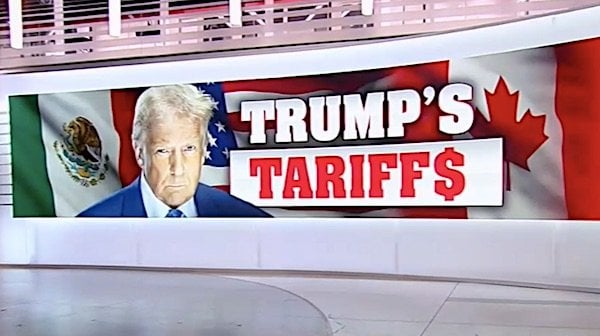
Some bad ideas, despite centuries of consistently negative consequences, come back to repeatedly haunt the human race. The economic warfare of “protective” tariffs is one such bad idea that belongs in the dustbin of history, yet President Trump has given it a veneer of patriotic polish, while trotting out all the tired pro-tariff cliches that have been proven so wrong for so long.
When a bad idea appears to have eternal life, you can bet its life support is coming from two major factors: 1) widely accepted myth and 2) powerful special interests.
The tariff myths are many, but the least obvious, and most pervasive, is the belief that tariffs are assessments levied against foreign countries, their producers and their foreign-made goods. In truth, foreign producers aren’t the ones who bear most of the direct cost. Who foots the bill for an American tariff on a foreign good? You do. It is in essence a consumer tax that lands squarely on your family budget, and reduces the buying power of every American’s wages. You are forced to either pay the extra sticker price of the foreign good or the higher cost of the “protected” American product.
I call it The Tariff Racket, because in the long run, the primary party that comes out ahead is the government itself. Think about it. Say you’re about to buy a foreign product that normally costs $100, but thanks to the Trump 25% tariff, you are roughly paying $125 for the same item. It’s not quite that simple, and depends in part on the elasticity of supply and demand for particular products. But the point remains that the tariffing government stands to reap the greatest benefit. The producer still gets $100. The government receives $25. You get the same product at an inflated price. Now think of this on a worldwide basis, as a hundred or more trading countries patriotically retaliate with tariffs of their own. What you have is an ongoing wealth transfer from the people of those countries to their governments. Consumers get smaller. Governments get bigger. That’s the net effect of “protective tariffs.”
Another prevailing myth is that American jobs and wages are protected by imposing tariffs. But in reality, tariffs merely prop up companies that are already noncompetitive compared with their foreign counterparts. Businesses that need protection are, by definition, businesses that are less efficient, less productive, and less capable of creating more jobs and higher pay on their own. The labor and financial capital that sustain these industries could doubtless be put to better entrepreneurial use. But instead, these powerful special-interest lobbies demand – and get – tariff protection that shields them from healthy market competition – competition that would either make them better companies or replace them with domestic industries that, within our unique American setting, can produce more economic output and more employment at lower consumer cost. There are innumerable examples of this very process throughout our history, including where entire regions pivoted away from certain industries (like textiles) into other forms of manufacturing that was competitive and profitable.
Economist Henry Hazlitt explains it this way:
“The effect of tariffs therefore, is to change the structure of American production. … It makes the industries that are comparatively inefficient larger, and the industries that are comparatively efficient smaller. In the long run, it always reduces real wages, because it reduces efficiency, production and wealth.”
Conservatives love to talk about “free markets,” but not so much about free trade. Yet what is a market but a platform for trade, i.e., for unencumbered transactions between willing sellers and buyers, in their mutual self-interest? Free trade and free markets are interchangeable terms. Why then, do politicians proclaim they want free markets within our own borders, but managed markets, walled off and weighed down with tariffs, everywhere else on the planet? The popular mantra on the right has been “fair trade, not free trade.” But by its very nature, free trade is fair trade in the truest sense – nationally and internationally.
Another widely-accepted fantasy is the presumed national harm from so-called “trade deficits.” Not only is the harm a myth, so is the term itself. In a free trade, free market environment, there is no such thing as a trade deficit, whether it’s buying and selling between New York and Namibia, or between New York and New Jersey. By definition, trade involves a willing seller and a willing buyer, for the self-interested benefit of each. Whether you are trading Chinese yuan for American soy beans or Federal Reserve notes for Chinese computers, a beneficial trade is a beneficial trade. Fiat “money” is traded for hard goods. As long as there’s no fraud or coercion, “trade deficit” is a phantom concept.
Consumers are the biggest beneficiaries of unburdened free trade. I invite the isolationists and tariff warriors to kindly explain to us how an American consumer who saves $5,000 buying a foreign car or $500 buying foreign electronics is hurting his country. Is driving a Subaru really unpatriotic? Or does basic economics teach us that free trade benefits everyone? That $5,000 the consumer avoided spending on a car will in turn be spent in local stores and restaurants, buying American-made goods and American-grown food. Meanwhile, the income other countries receive from American purchases comes back to us in the form of foreign investments that help relieve the recession-producing impact of our massive federal borrowing.
We recognize of course, that prosperity-producing free trade is not only encumbered by tariffs, but also by America’s bureaucratic Regulatory State, which directly and indirectly adds an avalanche of production costs to every product manufactured by our managed, taxed, licensed and controlled economy – invariably adding to the price of their goods and rendering those goods uncompetitive on world markets. But while we know that statism and authoritarianism are anti-competitive and anti-freedom, statist “solutions” like tariffs are not a solution to statist problems. Tariffs only exacerbate the problem and shroud its real causes.
Actually, America’s tariff train wrecks date back to our early days under the Articles of Confederation, when politically powerful merchants convinced their state legislatures to place heavy tariffs on competing goods from neighboring states. The result was economic disaster, with the very businesses tariff promoters claim to benefit most, being harmed the most by the closed-off markets and growing interstate animus. Only by the inclusion of the interstate commerce clause in the new Constitution was the nation cured of its internal protectionism.
Yet America hadn’t yet learned that international free trade was just as essential to our future prosperity. The disastrous Smoot-Hawley tariff bill of 1930, passed at the beginning of the Depression to protect American industry and workers from the “ravages” of free trade, had the predictably opposite outcome. Our “friendly” gesture of telling the world to stick their products up these noses, resulted in 25 of our biggest buyers of American goods telling us to do exactly the same – retaliating with massive tariff barriers of their own. What this accomplished was to make the Great Depression deeper and longer – especially for Americans.
Beware of those who revise history to justify bad policy. Trump’s version of the McKinley era tariffs takes us on a ride through the land of make believe, when those trade taxes reached average rates of 49% and were credited with boosting America’s tin production – a very visible benefit to that particular industry no doubt. But good economists, applying the principle of “what is seen and what is not seen,” have concluded that the widely dispersed and less obvious negative impacts on consumers and the U.S. economy as a whole far outweighed the narrow benefit to one or several industries. President McKinley himself publicly abandoned the tariff idea one day before his assassination.
Naturally, this raises the question of how America defends itself against governments that initiate tariffs against our goods first. Trump argues that Canada has been doing just that. Do we retaliate? When? How much? And what would be gained by this trade barrier standoff? It’s like two men facing off in a duel, pointing guns at each other’s heads from 2 feet away. The duelers get immediately enriched each time the guns are fired, even while inflicting mortal wounds on their long-term health. We consumers pay for the flint, powder and ball – and much more.
There’s a simple answer to the Reciprocating Tariff Engine that drives world trade off the cliff. It’s a solution requiring no political action from the nations of the world. Instead, we paint the politicians out of the picture. Nations put in place a logarithmic mechanism that automatically mimics any new or increased tariff imposed by another government. The “dueling politician” who stood ready to pull the trigger, now realizes that he’s pointing his pistol at his own head, and bringing about a self-inflicted wound on his own country. Maybe, he concludes, it’s time to put down his tariff war weapons, trade freely and compete proudly. Produce more. Buy more. Tax less. A novel thought.
I grant that tyrannical regimes that make slaves of their citizens, violate our patents, launch cyber-attacks on our shores, invade our borders and threaten our national security present serious challenges. We cannot be such “purists” that we blind ourselves to the harsh realities of a dangerous world, and of countries, cultures and governments that do not practice or respect freedom, the sacredness of life or the rule of law to nearly the degree America still does.
But the goodwill and interdependence created by trade, nation to nation, people to people, has a way of bringing the world and its people closer over the course of time. We can’t be naive about the goals and behaviors of totalitarian countries, but we must remind ourselves that tariffs always heighten international tension and conflict. Trade wars precede shooting wars, and in the wise words of economist Ludwig von Mises, “When people and goods cross borders, armies do not.” That’s probably the most important argument of all.
President Trump has a lot of good ideas, but tariffs, threats of tariffs and weaponizing of tariffs are not among them. Not in the long run. Let’s try peace and prosperity, through trade, instead. A truly radical – and world changing – idea.
* * *
Content created by the WND News Center is available for re-publication without charge to any eligible news publisher that can provide a large audience. For licensing opportunities of our original content, please contact [email protected].
This article was originally published by the WND News Center.