
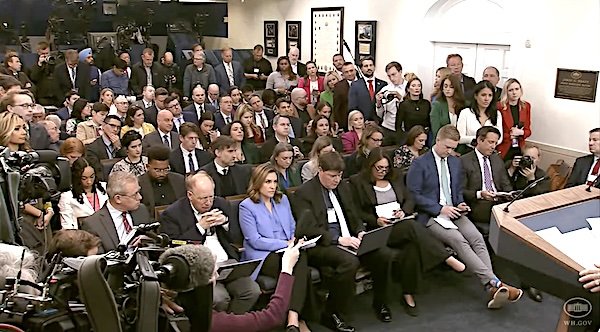

Elite reporters who have the privilege of attending White House news briefings actually considered an old-fashioned “sit-in” to try to keep their privileged seats amid a revolution in reporting.
For decades, writers for networks, legacy wire services, newspapers and the like have had privileged seats in the White House briefing room, specifically the front couple of rows have been reserved for them.
However, there’s now a revolution in reporting. Many people read X for their updates, and fewer and fewer are turning on television for a news broadcast or opening up a newspaper.
The latest confirmation of the changes is that the White House announced it would take over making the seat assignments for White House briefings, a privilege that for years had been gifted to the leftist White House Correspondents Association, a private organization of writers that essentially managed that briefing room for themselves.

Now the Gateway Pundit reports the legacy writers were so upset at losing control that they considered staging an old-fashioned “sit-in” to try to maintain their privilege.
The report took the WCHA members to task, describing them as “apparently a bunch of toddlers throwing a tantrum” over the change.
New: WHCA is considering how it would respond to the White House taking over the press seating chart in the briefing room. One idea: a “sit-in” style protest. pic.twitter.com/CqVntcUPyj
— Max Tani (@maxwelltani) March 31, 2025
They see seating privileges as akin to a civil rights struggle? What childish narcissists!
— Kevin Walker (@quevinhualquer) April 1, 2025
The report noted Semafor described how the White House plan to set its own seating chart “has rattled the journalists who cover the president and left them mulling how exactly to push back.”
The report said, “The WHCA’s current system reflects the 20th century media power structure: wire services and broadcast and cable television networks occupy the front row, major newspapers and radio get the second and third rows, and a more fluid collection of news organizations sits further back.”
The White House plan simply is to restructure the format to reflect today’s media trends, which are more and more web-, podcast-, and social media-based.